One traveler request can imply location, amenity, policy, comparison, availability, and experience needs, so test realistic intent sets rather than isolated keywords.
Overview
One ordered workflow for improving how a hotel is found, described, and recommended.
Executive recommendation
AI visibility is not adequately described by a page rank. A hotel is visible when AI systems can resolve the correct property, understand its facts and relationships, retrieve useful evidence, represent it accurately, include or recommend it for relevant traveler needs, cite credible sources, and identify a valid next action when the use case requires one.
Publish a transparent method before publishing any composite score. Declare the property and market, tested surfaces and product modes, versioned prompts, repeated-sampling protocol, evidence, formulas, source precedence, cadence, eligibility rules, and limitations. Keep foundational readiness and observed visibility in separate reports because they answer different questions.
Why AI visibility is not a ranking
Traditional search often moves from query to ranked links to a site. AI-mediated discovery can move from intent through research, retrieval, synthesis, recommendation, and an action without a site visit. A position alone cannot show whether the correct hotel was resolved, trusted, represented accurately, or given a useful path.
Clear, current, self-contained facts with adjacent support are more measurable than content volume by itself.
Canonical HTML, structured data, feeds, APIs, and relationships can aid access and interpretation, but implementation mechanisms are not outcomes.
Indexing, answer retrieval, model training, and action are not interchangeable. Every access or policy check must name the client and purpose being tested.
Two measurement tracks—kept side by side, never blended
Can a public reviewer determine that the hotel's information is accessible, unambiguous, retrievable, consistent, and action-ready? Use either a public outside-in review or clearly disclosed owner-assisted validation against private systems of record.
What do declared AI surfaces return, how often, with what representation and evidence, under a repeatable test protocol? Repeated sampling is required because answers vary by prompt, product mode, account state, market, and time.
A hotel may be technically ready yet absent from recommendations, or visible despite readiness defects. Report the two tracks together for diagnosis, but never convert them into one score.
This guide gives hotels one ordered workflow:
- Define the target guest and the property's genuine uniqueness.
- Audit the hotel's own site and retrieval readiness.
- Prepare clear, consistent, and credible content.
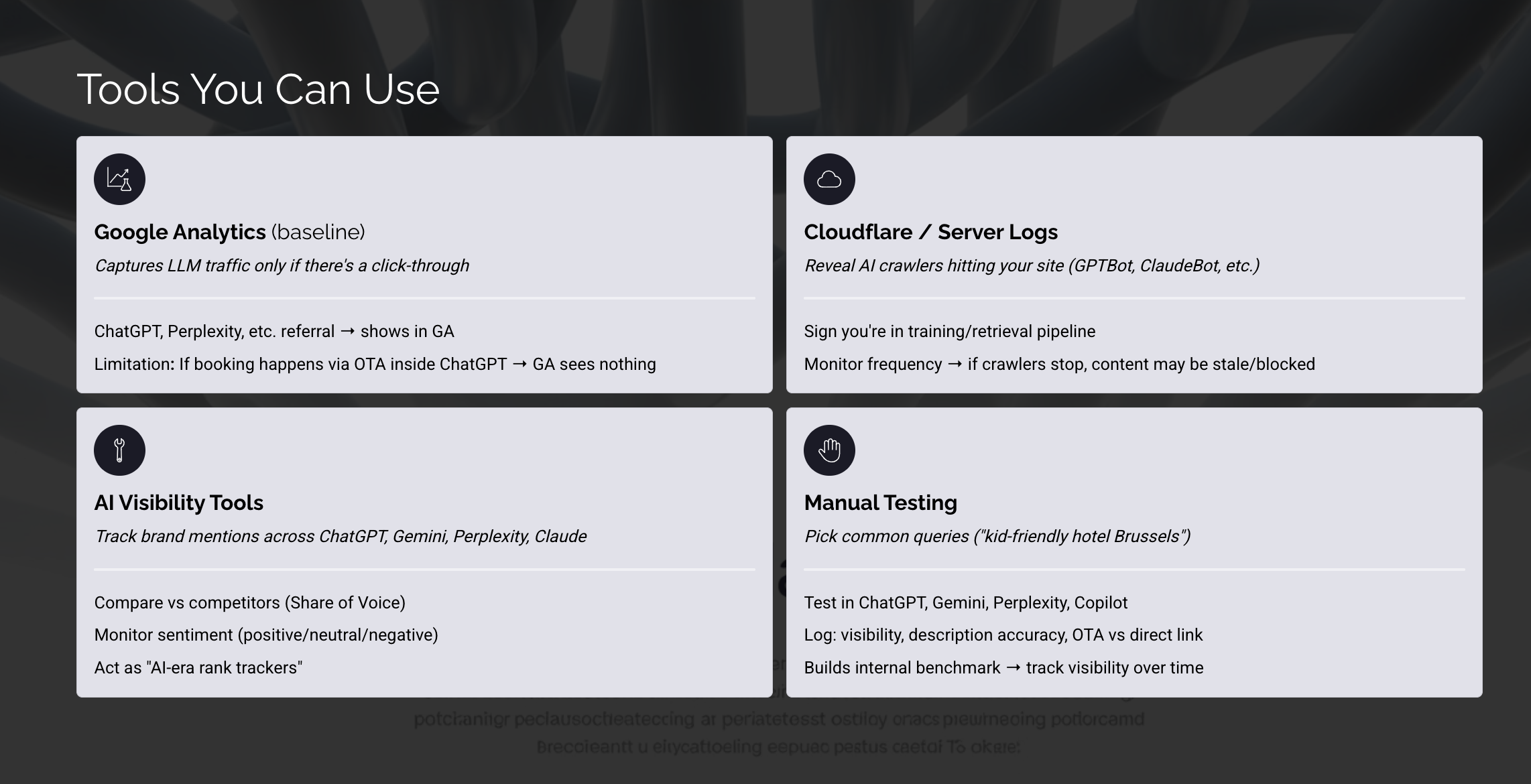
- Audit what AI answer surfaces actually say.
- Measure presence, accuracy, and recommendation or influence separately.
- Remediate the source of each failure and re-test.
Use the six-stage lifecycle as a diagnostic, not a score
01 · Found
Can relevant clients reach the evidence?Check crawl access, delivery, rendering, and indexing signals.02 · Understood
Is the correct hotel entity unambiguous?Check identity, attributes, identifiers, and relationships.03 · Retrieved
Are useful answer units extractable?Check intent coverage, page depth, structure, and readable facts.04 · Trusted
Do sources agree and support the claims?Check parity, freshness, corroboration, and evidence quality.05 · Chosen
Is the hotel included or recommended?Use repeated answer-side tests; do not infer this from readiness.06 · Action-ready
Is a current official path identifiable?Assess the path and public data only; do not claim a completed transaction.The guide does not promise that a technically correct site will appear in AI answers, and it does not treat one favorable answer as proof of performance. Indexing and retrieval readiness are foundational, but not sufficient.
Four hospitality standards to keep in view
These site-side statements are hospitality-specific. General web specifications do not describe everything a hotel needs to publish, so they complement—not replace—the official specifications listed in Resources. These are implementation statements, not scoring weights; evidence classifications are shown where assigned.
The property publishes complete lodging-type structured data covering rooms, amenities, rate context, and location rather than a minimal organization stub. Evidence: Signaled. Route: Agency or Auto.
The site answers, in the property's own words, the questions travelers actually ask—in extractable page text, not in PDFs, images, or steps inside a booking flow. Evidence: Signaled. Route: Content.
Core identity facts are consistent across the sources machines cross-check. Third-party and OTA profiles function as corroborating assets for the entity, not as competitors to it. Correct thin or contradictory profiles rather than treating them as the enemy.
The property publishes substantive neighborhood and destination context, not only on-property facts. Destination context is central to unbranded discovery questions such as where a traveler should stay near a place or experience. Evidence: Signaled. Route: Content.
Where this sits against SEO
AEO is not simply SEO under a new name. It is grounded in strong technical SEO, but optimizing for a retrieval system that composes an answer is a different problem from optimizing for a ranked list of links.
“AEO is just SEO.”
Different AI systems prioritize different data. Some partner with specific review or travel platforms, some draw on their own ecosystem, and some on their own social data. A property optimized for one is not thereby optimized for all.
“Low AI referral traffic means AI visibility does not matter.”
Zero-click interactions—where the system answers the traveler's question without sending them anywhere—are a large and largely invisible share of AI-mediated discovery.
“There is a platform to optimize for.”
Prioritize universal principles that apply across systems over guidance tuned to any single platform.
Scope boundary
This guide covers visibility and discovery. Static property information and dynamic availability, rate, and inventory information are in scope only insofar as they influence whether a property can be discovered or filtered. The outer boundary is what happens once a traveler or system moves from discovery into a commercial transaction. Transaction execution, payment, booking completion, conversion, revenue attribution, and emerging commerce protocols are outside this public flow. A useful official path and current rate or availability can be recorded only as pre-transaction readiness signals, never as proof of a booking or commercial result.
The approach is platform-neutral. It treats answer engines as changing surfaces and focuses on repeatable evidence rather than optimization promises tied to one provider.
Execution profiles
SMB / independent · Property level
Use a small approved profile set, the site-side checklist, a bounded multi-engine check, a fixed prompt sample, manual answer capture, the truth set, and a monthly review. Use agencies or vendors for technical checks that require access.
Enterprise · Corporate level
Maintain shared entity and attribute standards, a core prompt library with property exceptions, portfolio truth-set governance, approved measurement tools, multilingual and market coverage, centralized remediation, and portfolio reporting.
Franchisee / managed property
Own local facts and evidence. Route inaccessible technical failures to the brand or agency with exact findings, URLs, evidence, and owners.
Vendor-assisted
Require exportable prompts, observations, run metadata, citations, raw evidence, formulas, result states, exclusions, and remediation records. A score without the underlying evidence does not satisfy this guide.